
1. A certificate per product
Pick a product in Shopify, answer the rule questions, and get a CPC or GCC with every element of 16 CFR § 1110.11: certifier, records contact, manufacturer and each lab with email and phone, and the required attestation.
Shopify app · early access
CertFinch is a Shopify app we're building for stores that sell children's and other CPSC-regulated products. Make a CPC or GCC for each product, keep the lab reports with it, and have the three CPSC Product Registry IDs ready for Shopify's eFiling fields and your broker.
Built for the revised 16 CFR 1110 effective July 8, 2026, including the new email, phone and attestation elements.
General information, not legal advice. Not affiliated with or endorsed by the U.S. Consumer Product Safety Commission or Shopify.
Cite each "on certificate" rule separately. Check every rule against the linked CPSC page; your exact product may add or remove rules.
Free template + Shopify early access
A fill-in CPC and GCC template (Word, fillable PDF, and a printable version pre-filled with the citations above) with every element of 16 CFR § 1110.11 as revised for July 8, 2026. You'll also be on the list for the Shopify app.
Demo mode: no form endpoint is set in assets/config.js, so nothing was sent. Your answers are saved in this browser only.
Not legal advice. This tool gives general information drawn from CPSC guidance pages. It can miss rules that apply to your specific product, and it doesn't decide whether your product is a children's product (CPSC does). Confirm with CPSC's Regulatory Robot, a CPSC-accepted lab, the CPSC Small Business Ombudsman (SBO@cpsc.gov), or a qualified attorney before you certify.
Shopify app · early access
Shopify added fields for CPSC eFiling IDs to product disclosures in July 2026, but Shopify doesn't create your certificate or your Product Registry record. That part is still on you. CertFinch is being built to close that gap. Shopify changelog, July 10, 2026
Pick a product in Shopify, answer the rule questions, and get a CPC or GCC with every element of 16 CFR § 1110.11: certifier, records contact, manufacturer and each lab with email and phone, and the required attestation.
Keep the Certifier ID, Product ID and Version ID from CPSC's Product Registry on each product, ready for Shopify's eFiling disclosure fields and for your customs broker or carrier.
Store lab reports with each certificate, see which products still have no certificate, and get reminded when a new version or periodic retest is due. Founding price $19/mo (regular $39/mo).
Importers of products covered by a CPSC rule must file certificate data with U.S. Customs when they file the entry. Products entered from a Foreign Trade Zone follow on January 8, 2027, and international mail shipments on January 20, 2027 (see deadlines below).
CPSC: Certificates of Compliance and eFilingFull PGA Message Set: give your broker 7 data elements per product. Reference PGA Message Set: load the certificate into CPSC's Product Registry once, then give your broker 3 IDs (Certifier ID, Product ID, Version ID).
CPSC: eFiling FAQAny product requiring certification needs an eFiled certificate whatever the shipment value. Sales between consumers on online marketplaces count as commercial.
CPSC: eFiling FAQCPSC says it does not intend, at first, to ask Customs to deny entry solely for missing eFiling data. It will use the data to adjust risk scores, and it can still request seizure of non-compliant products. Source
Dates checked October 22, 2026 against CPSC, CBP and Federal Register sources.
July 8, 2026 · In effect
Every CPC and GCC must contain the revised 16 CFR § 1110.11 elements (including email and phone for each party and the attestation). Importers eFile certificate data with each entry for most imports. No de minimis exemption. CPSC
January 8, 2027
CPSC-regulated products entered from a Foreign Trade Zone must be eFiled too. CPSC eFiling FAQ
January 20, 2027
CBP will require its new electronic Entry Type 13 for international postal shipments under a partner agency's jurisdiction (such as CPSC) or subject to Section 201, 232 or 301 duties; otherwise formal entry is needed. From that date, CPSC will require eFiled certificates for mail shipments, via a Full or Reference Message Set. CBP suspended the de minimis exemption for mail shipments effective July 24, 2026 (91 FR 37801), and CPSC eFiling has no de minimis exemption either, so a low-value parcel isn't exempt. CPSC mail guidance (Oct. 2026) · CBP, Oct. 14, 2026
CPSC doesn't require a specific form. The certificate just has to contain every required element, in English. Under 16 CFR § 1110.11 as revised (effective July 8, 2026), that means:
New: if you rely on a statutory or regulatory testing exclusion, the certificate must name it in place of the test date and place for that rule. Read 16 CFR § 1110.11
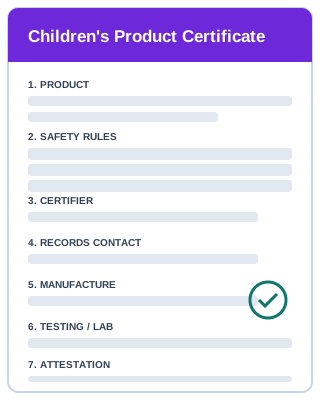
The free template has a labeled box for every element (including email and phone for the certifier, records contact, manufacturer and each lab), a lab-to-rule table with the most recent test date, a testing-exclusion column, and the exact attestation text. Each certificate covers one product, as the rule requires.
Get the templateA Children's Product Certificate covers products designed or intended primarily for children 12 and under, and it must be based on testing by a CPSC-accepted third-party lab. A General Certificate of Conformity covers regulated products for general use, and it can be based on a test of each product or a reasonable testing program, including first-party testing. CPC guidance · GCC guidance
For eFiling, the "importer" is the importer of record eligible to make entry. That can be the owner, the purchaser, or a customs broker. If the broker doesn't know enough about the product to be responsible, it can name the owner, purchaser, or consignee as the responsible party. If you're not the importer of record, ask your supplier for the certificate and its Product Registry IDs. Retailers and marketplaces will still ask you for it. CPSC: eFiling for importers
Registered Small Batch Manufacturers (no more than $1,436,864 prior-year revenue from consumer products, and no more than 7,500 units of the product) can get relief from third-party testing for "Group B" rules only. Group A rules always need a CPSC-accepted lab: lead in paint, durable infant products, pacifiers, small parts, lead in children's metal jewelry, and baby bouncers, walkers and jumpers. You still issue a CPC either way. CPSC: Small Batch Manufacturers
Usually not on its own. Since September 2025 Amazon has required that, for certain product categories, compliance be validated and submitted directly to Amazon by an Amazon-approved testing lab (TIC "Direct Validation") through Manage Your Compliance in Seller Central; sellers can't upload those documents themselves. Our template still helps you prepare an accurate CPC or GCC and the eFiling data, but it doesn't replace that lab step. Check your open requests in Seller Central. Summary by Intertek, an approved lab
No. You must furnish it to your distributors and retailers, and make it available to CPSC or Customs within 24 hours on request. Direct-to-consumer sellers don't have to give it to shoppers. CPSC GCC FAQ
No. A label is only one factor. CPSC also weighs packaging, marketing, how consumers see the product, and its Age Determination Guidelines. CPSC: Children's products
No. CertFinch is an independent tool and is not affiliated with CPSC or Shopify. The Shopify app is in early access and not yet available. It's general information, not legal advice. CPSC's own free Regulatory Robot and Small Business Ombudsman (SBO@cpsc.gov, 888-531-9070) are good next steps.
Checked October 22, 2026. Rules change, so open the source before you rely on anything here.